SteadyBlogging on Twitter (SteadyTweets?)

Thursday, May 12, 2005

Bush on Yalta

Wanted to post a couple links before I file away the e-mails by which they came to me. On Tuesday, Anj sent me this article, which appeared ironically in the Strib, that criticizes Bush's speech in Latvia last weekend. Then later the same day an e-mail from Slate featured this column, which also criticizes Bush for stabbing FDR and Churchill in the back.

I was wondering about Gwynne Dyer, the author of the first article. A Google search turned up that Jack Lessenberry had written an interesting column about him (here) in February. I started reading Lessenberry's column when I used to pick up a hard copy of the Metro Times each week in Ann Arbor. I've continued to read him online. But I think I must have missed that particular column about Dyer (which strongly recommeneds Dyer's book, Future Tense : The Coming World Order?)

From Latvia, Bush of course went to Moscow, and then made a stop in Tbilisi before heading to Western Europe. This story about Bush doing a Georgian jig caught my eye. But the visit to Tbilisi also reminded me that I'd been meaning to post the link to this interesting documentary I caught on KQED a few months ago (part of the fantastic Independent Lens series).

Tuesday, May 10, 2005

Architecture links

A few architecture links I've been saving to put up:
  • The NYTimes ran this prominent and positive review of the new Walker Art Center in Mpls. Remarkably I haven't been back to MN since Suvranu and Kriston's wedding, meaning June 2002. We'll have to try to get back sometime this year finally; if we do, we'll have to check out the new Walker.

  • Just today, the Times had this review of the new Holocaust memorial in Berlin. Another spot to visit someday.

  • Saved this link for the Times review of the new Caltrans District HQ bldg in downtown LA. Passed that on to Arun, who hit me back with this link to a Slate review of the same bldg.

    That link led me to a few others on Slate by that same writer, Christopher Hawthorne, including this photoessay on Koolhaas. I didn't save any of the reviews of his celebrated design for the new Seattle Public Library from a year ago, but after digging around on their site for a bit, found this extensive archive of articles.


  • Speaking of public libraries, I've been getting over to the SFPL more often in the past month. A couple times to the Main library, whose architecture I rather like, and a couple times to our Mission branch. (One of those trips to Main, picked up a nice book in the small bookstore operated by the Friends of the SFPL: "A Free Library in This City", which embeds the history of the SFPL within histories of libraries in general, and of the city of SF. And the book was only $5, as it is here.


  • Addendum, May 11: Just came across one more, a column by the prominent architecture critic Witold Rybczynski on "Chicago's Magic Kingdom", i.e., the Millenium Park in Grant Park.

Thursday, April 21, 2005

Last.fm

Much more on Last.fm later. For now, I wanted to see if the code they provide works: click on the following button to listen to a radio stream based on my last.fm profile:


Currently playing: "Chapter 13 (Rich Man vs. Poor Man)", one of my favorite tracks off of Resurrection. Before that: a 13-minute track off of Danny Hathaway Live, a J-Live track, a Biz Markie track, a track off of Kind of Blue....Hell, you can see for yourself what's being played on my last.fm page. Although the tracklisting there is an interleaving of the radio stream tracks I'm listening to right now with tracks being played through iTunes running on our computer at home. After dowloading the iTunes AudioScrobbler plugin yesterday, I've left Party Shuffle going so as to add more tracks to my profile.

Saturday, April 16, 2005

Broken beat

After doing that reggaeton post last night, I thought I might do another one or two posts introducing and collecting some links on certain musical subgenres. Check back here for a post on broken beat. A few of the links I'll work in:

Broke n' Beat Radio: "A Nu Jazz and Broken Beat mix show based in Philadelphia"

Benji B's Deviation show on BBC Radio 1xtra

This article from the Bay Guardian

Riddims by the Reggaetón

I'd been hearing about reggaeton here and there over the last few months--maybe I saw a disc in Cancun's jukebox? A flyer for a reggaeton show ended up on the sidewalk outside our place. Glanced at some mix CDs by local DJs at some show(s) we hit, and then a couple weeks ago read this blog entry by Jeff Chang (more about Chang and Can't Stop Won't Stop in a future post).

At the time I didn't follow the link to the Raquel Cepeda Village Voice piece that Chang links to. It was only today, as I was cleaning out the past few weeks' VV e-mailings that I opened up that article:

Riddims by the Reggaetón
Puerto Rico's hip-hop hybrid takes over New York
by Raquel Cepeda
March 28th, 2005 3:07 PM

The article is good primer on what reggaeton is and where it comes from ("an approximately 20-year-old fusion of dancehall, born in the poorest neighborhoods in Puerto Rico, with mostly Spanish-language rap and tropical rhythms"); and who to look out for (according to Cepeda: Ivy Queen, Daddy Yankee, Don Omar, and Tego Calderón. I'm thinking Cepeda is a writer to be trusted on matter like this. I'd been saving a Powell.com review-a-day from Salon of And It Don't Stop: The Best American Hip-Hop Journalism of the Last 25 Years, edited by none other than Cepeda.) It even comes with an accompanying compilation of links to sample the music online: Riddims on Demand: A Reggaetón Download Feast.

So I read the VV piece around lunchtime today. As I was walking back from 16th St. along Capp and passed Balompie Cafe, a concert poster caught my eye: Ivy Queen and Daddy Yankee at the top of the bill for a show at the Cow Palace in a week. Interesting coincidence, I thought.

After swinging by home, I strolled down S. Van Ness to the Post Office (to drop some checks for the taxman in the mail), made some phone calls while sitting in the sun outside the 24th St. BART station, and then walked back up Mission a couple blocks. Poked my head in a couple stores, and then saw that Musica Latina (Mission Music Center) had the same concert poster in the window. I took a look at some of the titles hanging behind and displayed under the counter. I didn't see anything I could recognize as reggaeton, and I headed toward the front door, but the store was quiet, so I had the chance to askthe guy working the counter if they had any reggaeton. Turns out they had plenty. His first recommendation was what I ended up walking out with--a CD/DVD set titled Chosen Few: El Documental, with the CD a collection of 25 tracks, the DVD a documentary about the music--all for only $10.

(If it turns out I and/or you need more: Guy also pointed out a 2CD/DVD set--top tracks from the past few years + the videos; while Chang recommends this mix.)

That remarkably affordable price is possible, I think, because it appears that the scene is still DIY and indie. There's no major label intermediating between the artists, the record store, and me. It may be because the hype hasn't yet filtered into their executive offices, or because reggaeton's creators have consciously held on to their creative capital. A Daddy Yankee quote in Cepeda indicates it's a mix of the two factors: " 'Reggaetón artists have learned a lot about business by studying hip-hop's history. Hip-hop had people who abused it and the first artists were taken advantage of,' says Daddy Yankee. 'We learned from it. And much like early hip-hop, the record labels ignored us.' "

I was taken aback to find, at the bottom of a flyer tucked inside the jewel case for El Documental advertising itself and some other upcoming releases, these words: "the freedom movement: FREEDOM is a movement of artists and producers who own their creative works which we deliver everywhere at revolutionary FREEDOM prices"

Speaking truth to power, and more power to them. Check the group that put out El Documental: Urban Box Office, which has lots of audio samples (and is selling El Documental for $7!).

Wednesday, April 13, 2005

Fukuyama on Weber

Brady told me he's still checking on me, so I'll keep up the new spate of entries, with a UofCentric post:

I was just cleaning out some NYTimes Books Update e-mails from the past couple months, and came across an essay by Francis Fukuyama on Weber's The Protestant Ethic and the Spirit of Capitalism titled "The Calvinist Manifesto."

Figured I'd save the link for if and when I ever get around to reading Weber. Weber's book was one of those handful of texts that it seemed like everyone at the UofC intersected with in some core course, but it was one that I missed out on. I was talking about this when I was hanging out with Jon Groat when I was in AA last summer for SMB, and so I borrowed his copy of his bookshelf (along with a couple other sociology books he recommended, all of which have merely been sitting on our bookshelf since then).

Another one of those UofCentric texts that I missed catching while there--and that I was recently thinking that I really should read--was Adam Smith's Wealth of Nations. I've had a copy of that one all along--I received it as a high school graduation present, paired with another such text: Tocqueville's Democracy in America. (Who gives such a present as a high school graduation gift? A UofC alum, naturally.)

Tocqueville I did read, in my Soc class, but I've been thinking about revisiting ever since. Which bring me to another link I was going to post...

The current Atlantic Monthly's cover story is the first in a series in which Frenchman Bernard-Henri Lévy reprises Tocqueville's journey through America:

The Atlantic Monthly | May 2005
In the Footsteps of Tocqueville
How does America look to foreign eyes? This year marks the bicentennial of the birth of Alexis de Tocqueville, our keenest interpreter. We asked another Frenchman to travel deep into America and report on what he found by Bernard-Henri Lévy

Edward Rothstein--who we learned, through his piece on Bellow that appeared last weekend (look here), was a grad student in the Committee on Social Thought (can't get much more quintessentially UofC than that)--wrote a piece on Lévy's project that was in Monday's Times: "Touring an America Tocqueville Could Fathom."

Tuesday, April 12, 2005

Freakonomics: Steven Levitt and Roland Fryer

Back in August 2003 I blogged (here) a link to a fascinating NYTimes Mag profile of a young UofC economist named Steven Levitt. (The original NYTimes link doesn't yield the full article anymore, but at the time I found this link that does.)

I was reminded of that profile because, first, the NYTimes Mag ran another very interesting profile of a young and unconventional economist a couple weeks ago: a profile of Roland Fryer, headlined "Toward a Unified Theory of Black America" (pdf).

The profile mentions that Fryer has collaborated with Levitt. In fact, both profiles were written by the same guy, Stephen Dubner, and now Dubner and Levitt have published a book on Levitt's work, titled Freakonomics. Just came across this excerpt in Slate, which describes some work of Levitt's and Fryer's on a typically atypical (and controversial) subject:

A Roshanda by Any Other Name
How do babies with super-black names fare?
By Steven D. Levitt and Stephen J. Dubner
Posted Monday, April 11, 2005, at 3:32 AM PT


The book's website is here.

Update (Sun, April 17): I was going to mention that Levitt & "Freakonomics" reminded me somewhat of Gladwell and his "Tipping Point", in a superficial way--popularizations of clever and counterintuitive explanations of social phenomena. Coincidentally, the newest addition to the NYTimes' op-ed roster of op-ed columnists, John Tierney, wrote a column for yesterday's paper about a public discussion between Levitt and Gladwell: "The Miracle That Wasn't"

Sunday, April 10, 2005

Saul Bellow roundup

I'd been thinking about blogging something about Bellow after a spate of essays about Augie March appeared last year, with the 50th anniversary of its publication. Below are a bunch of links that appeared after Bellow died last week.

First, for reference: the lengthy NYTimes obituary.

Also in NYTimes: A nice essay by Ian McEwan that ran on the op-ed page, centered around the barking dog of The Dean's December, touching on Bellow's stature among contemporary British writers. McEwan mentions this edition of Augie March with an introduction by Martin Amis which I'd like to pick up (searching for that link turned up links to this edition with an intro by Hitchens, and this nice Amazon feature by Aleksandar Hemon).

McEwan's essay includes a passage from Herzog which is, interestingly, as Hitchens cites in his Bellow obit ("He Was an American, Quebec-Born: Saul Bellow's legacy"), the epigraph of McEwan's new novel Saturday. More on Saturday in a later post (incl Hitchens' review of it), but for now back to Bellow--here are the famous lines from Herzog:

"Well, for instance, what it means to be a man. In a city. In a century. In transition. In a mass. Transformed by science. Under organized power. Subject to tremendous controls. In a condition caused by mechanization. After the late failure of radical hopes. In a society that was no community and devalued the person. Owing to the multiplied power of numbers which made the self negligible. Which spent military billions against foreign enemies but would not pay for order at home. Which permitted savagery and barbarism in its own great cities. At the same time, the pressure of human millions who have discovered what concerted efforts and thoughts can do. As megatons of water shape organisms on the ocean floor. As tides polish stones. As winds hollow cliffs..."

Of Bellow's novels, I've only read Augie March (in the summer after my first year of grad school, spent back at home in MN) and Ravelstein (about a year ago). I didn't feel like I really "got" either--in particular, I never really cracked Bellow's peculiar language. Which was the reason I gave up on Henderson the Rain King about 50 pages in. But in addition to a re-reading of Augie March, I'm adding Herzog (and perhaps The Dean's December and Mr. Sammler's Planet) to the near-term reading list.

Herzog is cited by Dave Eggers as "my favorite book, by anyone, anywhere, anytime" in this Slate collection of Bellow reminscences, which also has short pieces by Stanley Crouch, Hilton Als, James Atlas. While those were written in the days after his death, Salon's collection culled their selections from writers recounting their impressions of Bellow over the past 50 years. Slate also ran a piece about "Editing Bellow."

Returning to the NYTimes: there was the obligatory highbrow literary appreciation by uber-critic Michiko Kakutani ("Saul Bellow, Poet of Urban America's Dangling Men"), and two shorter, more anecdotal pieces: one by Brent Staples ("Mr. Bellow's Planet")
and one by Edward Rothstein ("Saul Bellow, Saul Bellow, Let Down Your Hair"). (Seems as if it's obligatory to headline these Bellow pieces with an allusion to a Bellow title--in which case I don't the last one.)

Both Staples and Rothstein were grad students at the UofC--their pieces come out of their (rather different) interactions and encounters with Bellow in Hyde Park. For my own small remembrance of Bellow, I was thinking I would pull out my copy of Staples's memoir Parallel Time and read the chapter about his stalking of Bellow in streets of Hyde Park. The piece above complements the Parallel Time chapter, with Staples evoking gossipy discussions of Bellow's latest novels taking place in Jimmy's. (As I've written before, I'm a fan of Staples's writing. I included in that entry links to two more of Staples' literary essays, one about Naipaul and one about Phillip Roth & Anatole Broyard.)


Finally, Bellow's city is of course Chicago (one of the reasons I feel a connection to him, even if I don't feel as if I have any sort of deep appreciation of his work). But the Times tries to claim him as <"A Writer Captivated by the Chaos of New York" as well.

Thursday, March 10, 2005

Chavez's Bolivarian revolution

Haven't been over to OpenDemocracy as much recently, but I did skim some of this essay about Hugo Chavez, and wanted to save the link:

All change in Venezuela’s revolution?
Ivan Briscoe
25 - 1 - 2005
After winning two elections and one referendum, defeating a coup and surviving four general strikes, Venezuela’s maverick president Hugo Chávez seems impregnable. But where is his “Bolivarian revolution” going? Ivan Briscoe reports from Caracas on a convulsive, divisive, history-haunted social experiment.

Monday, February 28, 2005

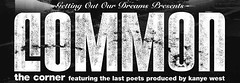
Common - The Corner video


Time for another resurrection of the blog. So it's appropriate this post is about Common.

I must have signed up for the mailing list on Common's site a while back (something I've done at way too many websites, though I still don't get an unmanageable amount of spam somehow).

Nothing much had come through Common's list lately, but this weekend I got an e-mail promoting the digital release and the video for his new track, "The Corner." I've listened to it a few times over the past month. It was either leaked or surreptiously released digitally, as it appeared on a bunch of audioblogs around the same time. I got it from this post on Soul Sides, the one audioblog I've been frequenting most frequently. Brady later pointed out that it had appeared on others, such as this post of Cocaine Blunts.

Enough with the audioblog links. Here is where you go to view the video for "The Corner", which I highly recommend you do, esp if you've spent some time in Chicago. Some highlights: plenty of shots of the lake and skyline (to give you a warm embrace, so to speak)...cruising South Side streets ("the stories told by Stony and Cottage Grove")...Common rapping on the corner--down the street from an El station...numerous shots of el trains and tracks (reinforcing the idea that a motif in Common's writings is public transportation as a public space: "sometimes I take the el/to gel with the real world...")...the projects (Robert Taylor & Ida B Wells?)...

Overall, Kanye does a good job directing.

Had a thought to put up some other hip hop links, related to the few shows we've been to in the new year (Questlove spinning a set at Club Six in back in January, Crown City Rockers tearing the roof off of The Independent in early Feb, and the Stones Throw show at Mighty a couple weeks ago (for which you might find the flyer here))...I'll maybe come back to those in a future post.

(Although the show wasn't all that, it's alway interesting to drop by the Stones Throw site. For example, they've got something up about the upcoming release of a compilation of psychedelic West African funk/soul...and a peek at the DJ Rels page revealed a 30-minute RealAudio mix, which I'm listening to and recording right now (with a new and hopefully improved version of iRecordMusic) ).

One last link: surfing to Common's site led me back to okayplayer.com, which I hadn't visited in a while. Got to make it a point to put that back into the daily operation, if only for The Boondocks. Check out today's edition here.

Friday, February 04, 2005

South America: Dec 21 (Santiago wineries)

At this rate it's going to be next December before I finish recapping our trip. Here's an account of our next day, Monday Dec 21:

This was sort of a wasted day. The downside of being on a tour where the itinerary is set--this day was spent visiting two wineries on the outskirts of Santiago. Anj and I (esp Anj) aren't all that into the winery-visit thing, so in retrospect we would have liked to have spent this day otherwise. To explore Santiago, say; or, as Anj pointed out, we could have made a daytrip to Valparaiso. (The latter seems esp appealing after reading what for me was the best chapter of "Clandestine in Chile"--"Two of the Dead Who Never Die: Allende and Neruda", regarding Valparaiso and nearby Isla Negra. )

Eugenio and Marcelo picked us up at the hotel and drove us to Cousino Macul, a small winery. There was the usual tour of the cellars, the big oak barrels, the tasting. We did meet a couple interesting people. Unlike the subsequent tour of Concha y Toro, there were a few other younger people on the tour with us at Cousin Macul. One was a Portugese guy, who it turned out had was in the final days of a five month trip through Central and south America. He had started in Cuba, travelled through Central America (incl a 4 week Spanish course in Guatemala), and then to Ecuador, Peru, Bolivia, and finally Chile. We also met a young Brazilian couple from Fortaleza (in the NE of Brazil, as we later looked up). I ended up exchanging contact info wih the guy, as he expressed interest in visiting San Francisco (and esp after visiting Rio, we hope to travel through Brazil sometime). He spoke English rather well--turned out he had spent a year of high school in Washington state as an exchange student.

We drove from Cousino Macul towards the site of Concha y Toro. I wrote in our journal that Eugenio started discussing Pinochet and Allende with us, but don't remember specifically what. We did make an interesting stop at a scenic roadside spot (in San Juan?). There were stone blocks memorializing, Eugenio explained, an assassination attempt on Pinochet; it took a couple questions before we understood that the town had erected this as a memorial to Pinochet's bodyguards who died defending him. (It must have been the assassination attempt in 1986 described here.) A couple photos here.

After lunch on the patio of a nice place across from the entrance to Concha y Toro, we endured the lengthy tour there. The grounds were beautifully landscaped, and featured live chickens, pheasants, and sheep wandering arounds, but the sun was intense and the tour was the usual. It was mostly older (and no doubt wealthy) Americans on this tour; we met, for example, a trustee of the University of Alabama who was playing with his fat new Nikon digital camera.

On the drive back to Santiago, Anj and I got to tag along for the first "professional visit"--a stop at a private hospital, Clinica Santa Maria. It was very modern and clean--better facilities than usually encountered in the U.S.--but private and rather expensive. In fact, the prices for seeing a doctor, for a night in the hospital, etc., were listed up front, on the wall as you checked in. This was an unplanned visit, but Eugenio got the receptionist to find a doctor who spent a few minutes talking with us, and walked us through the emergency rooms.

We got dropped off at the hotel, and walked over to Cerro Santa Maria. Oddly, we had to sign in before entering the park. Cerro Santa Maria was another spot that I thought I vaguely recognized from "El Gringuito", and as in the movie, and as Anj and I had noticed elsewhere, there were a number of PDA-uninhibited young couples. I was surprised to later read Littin mention this in "Clandestine in Chile" as well: "What most caught my attention that Friday, after so many years away, was the number of young lovers strolling the terraces that overlook the river. Arms around each other's waists, they seemed to be loving one another slowly, heedless of the time slipping away pitilessly. Only in Paris had I seen so much loving in the streets, and that was years ago. I remembered Santiago as a city of private sentiments. Now I found myself witness to s sight that had gradually died out in Paris and was, I thought, gone from the world. I thought of something that I had heard not long before in Madrid: 'Love blossoms in times of the plague.' "

Some photos we took at Cerro Santa Maria here.

We walked back along the sidewalks of O'Higgins Boulevard, which were now packed, with people going home from work, and going in and out of the stores. We stopped in a couple, as I started looking for soccer jerseys. The stores were packed, department stores that could be in a U.S. mall. But I was unsuccessful in finding any soccer gear, until we noticed that one of the blind street merchants--there were quite a few--had Argentina and Brazil t-shirts. I bought one of each for him, for 4000 peso apiece (approx 6 dollars). Another street vendor who sat next to him, this one with sight, helped complete the transaction.

Eugenio later mentioned to us that the government has encouraged and licensed such street vendors. Conversely, we noticed how few beggars/panhandlers we encountered in our limited experience walking around the city.

We had dinner that night at Le Due Torri, a nice Italian place not far from the hotel, on the recommendation of the concierge. This was our first extended experience trying to order in Spanish. Although the waiter didn't speak much English, he was patient and helpful, and even pulled out a Spanish-English cheat sheet from his wallet (though after we got our orders, we thought he may have had some stuff wrong on his cheat sheet).

After dropping off the parents, Anj and I headed off the Suecia, the nightlife district. Since it was Monday, it was pretty quiet along the 3 or 4 blocks that were lined with bars and clubs. We could envision it being quite a scene on the weekends. Many of the places had people outside trying to recruit passersby into their joints. After walking the whole length, to the river, we walked back to one of these places, "Louisiana" where one guy had hooked us by talking to us in English as we walked by. Turned out he too, had spent quite a bit of time in the U.S. In fact, he'd spent much of his childhood in Miami, where his parents had moved--until he got deported a couple years ago, after getting involved with some gangs, which led to an armed robbery of a jewelry store.

We had a couple beers at that spot, listened to a sort of folk-y singer do some covers of American songs from the '70s (he looked what I imagine is a Chilean stereotype, kind of hippie-ish, with long hair and an acoustic guitar--though I'm not sure where I picked up that stereotype), and then cabbed it back to the hotel.

Sunday, January 23, 2005

South America recap: Dec 20 (Santiago)

My first stretch of blog-rot since switching over here to blogger at the beginning of November. Been meaning to write up an account of our trip since we got back three weeks ago, but haven't found (initially) the time nor (subsequently) the energy to do it. Time for another resurrection...

Wanted to write up a recap of our trip to South America before the recollections start fading. Though this time we did a better job of keeping a journal, so I'm going to work off those notes, and of course add some links here and there. I'll also try to tie my writeup to the photos we've uploaded to Shutterfly; the whole bunch is here, but I'll break them up and intersperse links to specific photos in my account.

The travels actually started Sat, Dec 19 in Miami. Anj and I got there in the morning, after a red-eye from SFO. We found Anj's parents at the hotel near the airport where they'd spent Friday night, after flying from Detroit the previous day. The four of us spent Saturday driving around--lunch on Calle Ocho in Little Havana, a drive to Key Biscayne, and then to South Beach, where we had an early dinner before driving back to the airport for our flight to Santiago.

We flew in to the airport Sunday morning (Dec 22), over the mountains. After getting through immigration and paying the fees, we got our luggage and found our group--our guide for Santiago, Eugenio, and driver Marcelo, and the couple that completed our tour group, the Smuklers of Santa Monica.

The sun was intense, but the weather was pleasant. My recollection of the drive from the airport into the city center is that it was fast and efficient--a big wide highway into the city, streets mostly devoid of people in the city. Some of my most vivid memories of our family trips to India are of those initial taxi rides from the airport through the length of Calcutta--the chaotic scenes and inching paces of those first-impression rides were nothing like this first impression of Santiago. Though to be fair, the same trip in Calcutta today is nothing like it was in the 80s.

It was interesting also to later read Garcia Marquez's rendering of Miguel Littin's account of his return to Santiago in "Clandestine in Chile", which Anj and I read only later in the trip: "Santiago was a radiant city, its venerable monuments splendidly illuminated, its streets spotlessly clean and orderly....Starting at the historic Central Station, designed by the same Gustave Eiffel who built the tower in Paris, the endless Bernardo O'Higgins Boulevard flowed before our eyes like a river of light."

Since it was the middle of a Sunday afternoon, we didn't see the monuments illuminated, though we did catch glimpses of this over the next couple evenings. The streets did indeed seem orderly and clean, though not spotless. There was a profusion of graffitti, certainly--which probably wasn't there in 1985, when Littin returned to a Santiago under Pinochet's rule, after 12 years in exile.

(Most of the graffitti was typical uninspired scribbled tags, but occasionally we saw something cool this this.)

Eugenio pointed out the Central Station as we turned on to O'Higgins Boulevard, where our hotel was located. Unfortunately I don't remember seeing the Moneda Palace, though Eugenio must have pointed it out to us as well, since at the time I didn't even begin to understand its historical significance. The passage above from "Clandestine in Chile" continues: "All at once, the Moneda Palace loomed into view on my side of the taxi like an unwelcome apparition. The last time I saw it, the building was still a burned-out shell covered with ashes in the aftermath of the coup."

We checked in to our hotel, the Plaza San Francisco (from one SF to another, for me and Anj)--a nice if somewhat stuff hotel, with a great central location that unfort we didn't have much to take advantage of. Even though Anj and I had had two straight nights of red-eye flights, we didn't get to rest right away, since we had a city tour for the afternoon.

The first stop was the Museo Precolombino, a not overly large but extensive enough museum of pre-Columbian art and culture. Eugenio gave us an enthusiastic, informative, and extensive guided tour of the exhibits--art and artifacts of the cultures of Central and South America that thrived prior to the arrival of Columbus and the Europeans: Aztec, Mayan, Incan, Mapuche, and others. (See these photos.)

This was certainly a good way to start the trip, with a primer and reminder of Latin America's pre-Latin culture. But in retrospect the visit to the museum stands out as in contrast to the rest of our itinerary, where it seemed like European cultures had largely supplanted overt signs of those areas' pre-Colombian cultures. In Chile the connection is still perhaps still there, with our guide Eugenio stressing that many Chileans, himself included, are proud of their Mapuche heritage (see the last photo in the link above of Eugenio explaining "Tres Siglos de Plateria Mapuche"). But in the Lake District of Chile, it was the German character of the culture and people that stood out; in Argentina, the synthesis of Spanish and Italian cultures; and in Rio de Janeiro, the synthesis of Portugese and African.

Architecturally as well, what stood out in the cities of Santiago, Buenos Aires, and Rio was the diversity of European styles that were exhibited. Eugenio had pointed this out on O'Higgins Boulevard as on the ride from the airport to the hotel, and it was on display again in Plaza de Armas, Santiago's central square, which we walked to from Museo Precolombino: Spanish, French, Italian, modern. The canonical postcard from Plaza de Armas is the sleek glass skyscraper towering over the ornate Italian-style cathedral. (See these photos of Plaza de Armas.)

After a walk through the cathedral (also named for San Francisco!), we got back on the bus and went to the top of Cerro San Cristobal, with its striking views of the sprawling city surrounded by mountain peaks.

(I recognized Cerro San Cristobal, as well as a couple other parts of the city that we caught glimpses of over those two days, as sites of scenes from "El Gringuito", which I'd seen in November at MCCLA. Related note: Anj noticed this review in the NYTimes last week of "Machuca"--also a Chilean movie set in Santiago, about a young boy's coming-of-age, but
this one is set in 1973. Turns out the director of photography is none other than Miguel Littin! The latest issue of The Nation also had a review.)

From Cerro San Cristobal we drove through a posh neighborhood--palatial homes set in the hills above (north of?) the city--followed a stop at a lapis lazuli shop.

We finally got to rest at the hotel for a few hours. While Anj napped, I turned on the television, figuring that there had to be some futbol on. Sure enough, as I was to find throughout the trip, there's rarely a lack of futbol to watch. I found a few channels worth
then--a Spanish La Liga game on ESPN+ (Sevilla v Real Betis, en vivo), and a Chilean league game on ESPN. Caught the end of a program about the history of the game which preceded the latter on ESPN, with some footage of Eusebio from the '66 Cup.

A nice feature of staying in a hotel in a large city that caters to international (and in particular business) visitors is the selection of news channels. Flipped through CNN International (seemed so much superior to the CNN you get in the US), BBC World, RAI, TV5, .... It reminded me of the turning on the TV when we stayed in a Marriott on Juhu beach in Mumbai. I was amazed at the number of languages you could hear.

I couldn't sleep or even sit still, so I ventured out to check my e-mail. The rates for the computers at the business center in the lobby of the hotel were exorbitant, so I asked the woman working the desk for directions to nearby internet cafes. I walked across O'Higgins Boulevard and through a couple pedestrian-only streets. Though it was Sunday afternoon and perhaps only half of the stores were open, there were still a large number of people out. I walked by some semi-organized performers--a dance troupe--and a number of bookselling stalls, reminding me a bit of Calcutta, before finding an internet/call center, where I got on a computer, wrote some e-mail and made a quick blog entry.

Dinner that evening was at the hotel restaurant--ceviche, beef, wine, our first taste of pisco sour.

Tuesday, December 21, 2004

Beinhart´s ´´A Fighting Faith´´

I can hardly believe I´m sitting here in Puerto Varas reading TNR, but so it is. I finally started reading through Beinhart´s much-discussed (w.r.t. a certain liberal overread segment of the population) piece in TNR, which I previously blogged last week. Just wanted to reiterate that it does appear to be required reading if you care about liberalism in the United States (and thus, by extension, an alternative and an opposition to the apparently acsendant right wing in our country).

I haven´t read the whole thing, so I´m not claiming I agree with the thesis. But it´s an argument you need to be aware of.

A key paragraph early in the piece that essentially states the thesis (read the intro of the piece to understand what he means by ´´a Wallacite grassroots´´ and a ´´meeting at the Willard Hotel´´):

When liberals talk about America's new era, the discussion is largely negative--against the Iraq war, against restrictions on civil liberties, against America's worsening reputation in the world. In sharp contrast to the first years of the cold war, post-September 11 liberalism has produced leaders and institutions--most notably Michael Moore and MoveOn--that do not put the struggle against America's new totalitarian foe at the center of their hopes for a better world. As a result, the Democratic Party boasts a fairly hawkish foreign policy establishment and a cadre of politicians and strategists eager to look tough. But, below this small elite sits a Wallacite grassroots that views America's new struggle as a distraction, if not a mirage. Two elections, and two defeats, into the September 11 era, American liberalism still has not had its meeting at the Willard Hotel. And the hour is getting late.


My excuse for reading this while I should be sleeping: I´m cleaning out my yahoo inbox, and the connection is so slow--or rather, so narrow--that while waiting for the next message to load, I have time to do another task--multitasking, in the original OS sense of the word.

from Puerto Varas

A quick and short post. It´s 12:30am, Monday going into Tuesday. At the internet stations in the lobby of Hotel Cabañas del Lago, in Puerto Varas, in the Lake District of Chile. Arrived in the Lake District around 1pm this afternoon, after a short and enjoyable LANChile flight from Santiago--enjoyable primarily b/c of the Andes which ran along the left (east) side of plane for nearly the entire length of the flight. The geography of this country is amazing.

Lots to catch up regarding the approx 54 hours since I last posted: yesterday was primarily visits to two wineries near Santiago, plus a short visit to a hospital in Santiago. Some other details, but those will have to wait. Flight this morning, followed by a good tour of Puerto Montt and Algema (¿), then check-in here, a walk to the center of Puerto Varas (the highlight: the Colo-Colo jersey I found in the sporting goods store there), dinner here at Cabañas.

Tomorrow and the next day should be interesting. Tomorrow, a bus and then a boat to Peulla. We spend the night there, and the next day a bus, a boat, and another bus, across the border into Argentina, to Bariloche.

Apredieno mucho español aqui...

Sunday, December 19, 2004

From Santiago

Writing this from an internet/phone store in Santiago. Just a couple blocks from our hotel (Plaza San Francisco, ironically). It´s now 6:20pm. We arrived here this morning; our flight landed around 9am.

It´s been a busy couple of days since Anj and I left home Fri evening. Took a red-eye (via Las Vegas) to Miami. Spent Saturday around Miami--lunch in Little Havana, a drive to Key Biscayne, drinks and dinner in South Beach--before flying out around 11pm, on another red-eye. Needless to say, we´re pretty sleep-deprived. Hence Anj is napping in the room, but I´m still going on that sleep-deprivation buzz I get going sometimes.

We had a tour of the city today, straight from the aeropuerto practically--just a quick stop to check in to the hotel, and then we were off. First stop was Museo Precolumbino--a not large, but extensive enough, collection of pre-Columbian Central and South American art and culture. Our guide, Eugenio, was quite knowledgeable about the exhibits, and gave us an informative and exhaustive (and exhausting) tour of the exhibits.

That was followed by a visit to the central plaza and the cathedral, and then a drive to the top of Cerro San Cristo (?), a posh neighborhood in the hills, and lapiz lazui shop.

More later...

Tuesday, December 14, 2004

4 hero remix of "sexual healing" on bbradio

Anj has been telling me to send her some links to mixes that she can listen to at work. Finally sent her a handful of links. The full list is below, but I wanted to single out one link in particular. This edition of Broken Beat Radio, which includes a characteristically sublime 4 Hero remix of Marvin's "Sexual Healing" (about 13 minutes into the mix).

There's been a lot of remixing and recontextualizing of Marvin lately. There was a remix of "Let's Get It On" discussed in this Slate piece, which I previously blogged here;(don't sleep on that 1984 W. Kim Heron piece either); and the "duet" with Marvin that Erick Sermon put out a few years ago. I never pass up a chance to blog a Mark Anthony Neal essay--so here's his Critical Noire piece on it:

CRITICAL NOIRE
The E-Double and the Trouble Man: Marvin Gaye and Erick Sermon "Turn on Some Music"
by Mark Anthony Neal
[30 August 2001]

(I previously blogged Neal's pieces here, as well as a couple other places on the old blog; do a search for "Neal.")

Here's the full list of sites I sent to Anj:
http://www.futureboogie.com/

has lots of good real audio mixes with tracklistings.
mostly new jazz/broken beat, but sort of mellower.

http://www.boombasticradio.com/
you can listen to this through itunes (look under Radio -> Urban)...
the website has a list of currently and recently played tracks.
it's an eclectic mix of jazz, funk, hip hop, jazz, reggae...

http://www.wefunkradio.com/
this has hundreds of radio mix shows archived. funk and hip hop.
you can take a look at the playlists. they have mp3s up on their site,
but they also stream a show through itunes (same place, Radio -> Urban)

http://www.brokenbeatradio.com/
this site has tons of mixes as well: "A Nu Jazz and Broken Beat mix show
based in Philadelphia..." you can stream or download from their site.
(the newest one has a theo parrish track, a bugz in the attic track...
and a 4 hero remix of 'sexual healing'!)


Monday, December 13, 2004

TNR: "A Fighting Faith"

I haven't been keeping up with Josh Marshall's Talking Points Memo as regularly over the past month, but last week while skimming TPM I did notice a few mentions of this piece in The New Republic, which apparently has been quite the topic of discussion:


AN ARGUMENT FOR A NEW LIBERALISM.
A Fighting Faith
by Peter Beinart
Post date 12.02.04 | Issue date 12.13.04

Haven't read it yet, which is partly why I'm posting it--to archive the link and to remind myself to get back to it. See also Marshall's comments on that essay in this TPM post.


"Losing your mind in Berlin"

Meandering and often pretentious but still interesting profile of Richie Hawtin and the techno scene in Berlin:


Losing your mind in Berlin
Nowhereland: Hawtin, Magda and the Berlin scene
by Walter Wasacz

Here, where time and place exist in blurry, indistinct partnership, and where day and night pass largely unnoticed through the perpetually bleak environs, Richie Hawtin is glowing in the ambient light. A muted blanket of artificial sunshine brings color to his face and reveals tone in his arms, which he uses to emphasize and punctuate his words, now coming at you fast and from multiple directions.
http://www.metrotimes.com/editorial/story.asp?id=6949


Among other things, the article reminded me that I need to seek out some music of Ricardo Villalobos, whom the article describes as "a tall, buoyant Chilean-German who produces an elegant blending of minimal techno and Latin house that some argue might be the best dance music being made today."

Friday, December 10, 2004

download this: konfabulator

Just one post for today: this looks to be a nice piece of software. Actually, it's a wrapper for multiple pieces of useful software ("widgets"). I just installed it on my machine here at work, and for a taste the installer put a clock, the local weather, a to-do list, a search toolbar, and a picture frame on my desktop.

There's many more in the Widget Gallery.

Thursday, December 09, 2004

Books: Hornby, D. Foster Wallace on the Borges bio, ....

Thought I'd post this Salon link since Joel said he was thinking of going to see Hornby read in NYC this week:

"The Polysyllabic Spree" by Nick Hornby
From the author of "High Fidelity," a delightful celebration of the joys of reading that reminds us why most literary criticism is so bad.
By Charles Taylor

That's a review of a collection of Hornby's essays from The Believer. I previously blogged The Believer here, in particular that tremendously fascinating interview with ?love. (I'm just realizing now the interviewer there was Toure! Saw him read from Soul City--and bought a copy of The Portable Promised Land--at Cody's in Berkeley back in Oct.)

Some more literature links: going through piled-up NYT e-mails, and noticed that David Foster Wallace, who I mentioned here, had written a review of the very same Borges biography that I discussed here. From the Nov 5 Books Update e-mail:

1. In Sunday's Book Review: David Foster Wallace on the Life of Jorge Luis Borges
============================================================

"Edwin Williamson is an Oxford don and esteemed Hispanist
whose 'Penguin History of Latin America' is a small
masterpiece of lucidity and triage. It is therefore
unsurprising that his 'Borges' starts strong, with a
fascinating sketch of Argentine history and the Borges
family's place within it. ..."

"The big problem with 'Borges: A Life' is that Williamson is
an atrocious reader of Borges's work; his interpretations
amount to a simplistic, dishonest kind of psychological
criticism. You can see why this problem might be intrinsic to
the genre. A biographer wants his story to be not only
interesting but literarily valuable. ... Biography-wise,
then, we have a strange situation in which Borges's
individual personality and circumstances matter only insofar
as they lead him to create artworks in which such personal
facts are held to be unreal."
http://www.nytimes.com/2004/11/07/books/review/07WALLACE.html?8bu

First Chapter
http://www.nytimes.com/2004/10/31/books/chapters/1031-1st-williamson.html?8bu


Same edition of that Sunday's Book Review had these two reviews worth archiving:

'Men and Cartoons': The Superhero Next Door
Review by JAY McINERNEY
Jonathan Lethem's new story collection features talking
livestock, sci-fi detectives and a comic-book sensibility.
http://www.nytimes.com/2004/11/07/books/review/07MCINERN.html?8bu

-----

'Perilous Times': War of Words
Review by CHRISTOPHER HITCHENS
Geoffrey R. Stone's book is a history of the government's
struggle with the right to free speech during military
conflicts.
http://www.nytimes.com/2004/11/07/books/review/07HITCHENS.html?8bu